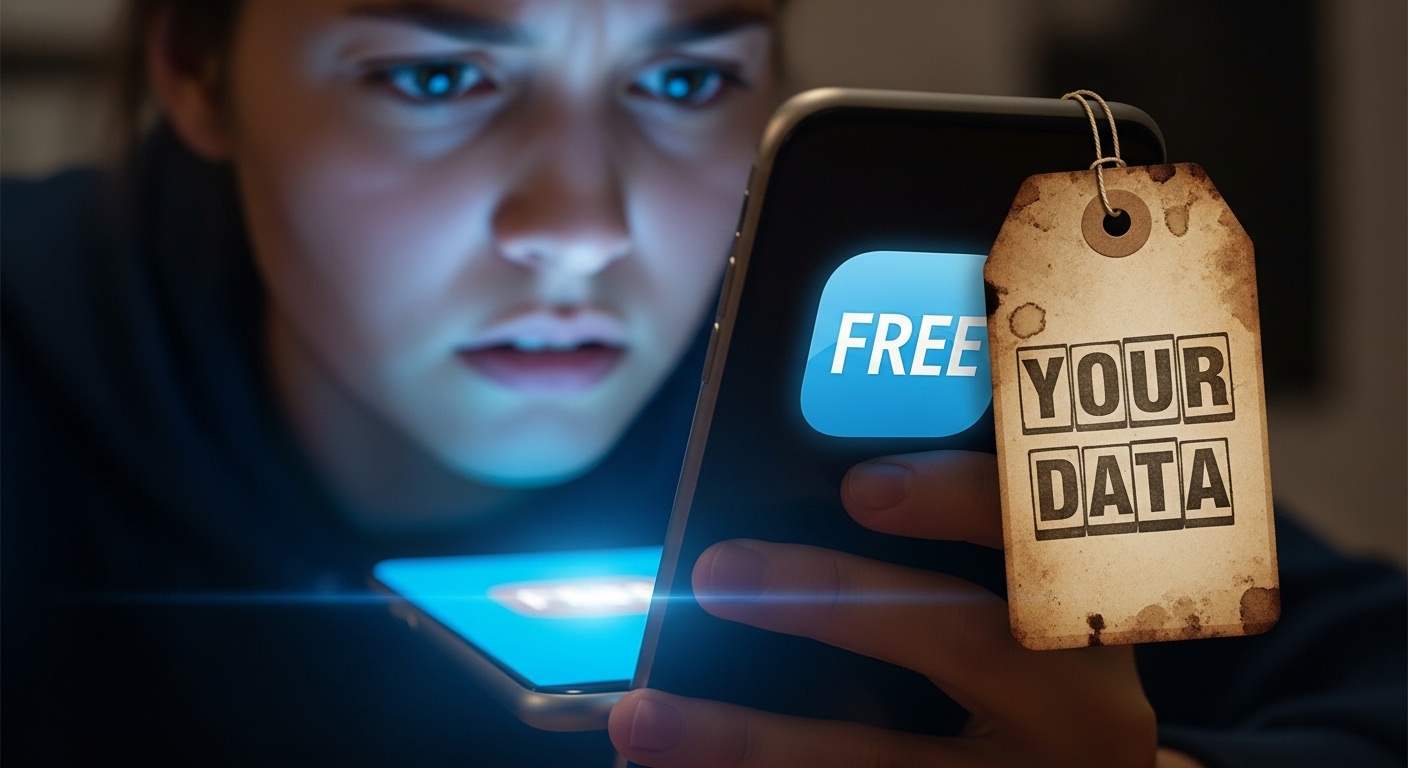
We love free stuff. Free email. Free maps. Free budgeting apps. But in 2026, we need to stop pretending "free" means "zero cost." If you walk into a dealership and they give you a free car, you'd check the trunk for a body. Yet we hand over the keys to our digital financial lives for a free app without blinking.
There is always a bill. The only difference is whether you pay it with your credit card or your privacy.

The Data Broker Economy
Let's pull back the curtain on how the "free app" economy actually works. It's not magic; it's an auction.
I want you to try an experiment. Open your current "free" finance app. Look for the "Partners," "Offers," or "Marketplace" tab. It's usually front and center.
See that credit card recommendation? That's not there because it's the best card for you. It's there because that bank paid the highest "bounty" (often $100-$300) for your data profile.
To get that bounty, the app typically shares:
- Your Income Stability: Not just how much you make, but how consistently. Are you a freelancer? High risk. Data brokers like Acxiom and Experian package this into "Risk Scores".
- Your Credit Score Range: Often pulled via "soft checks" you agreed to in the fine print.
- Spending Habits: "User spent $400 at airlines last month." Label: High-Value Traveler. Sell to: Chase Sapphire.
- Life Events: "User spent $200 at PetSmart." Label: New Dog Owner. Sell to: Pet Insurance.
You are not a user. You are a bundle of leads to be sold.
Why "Anonymized" Is a Lie
Companies love to say they only share "anonymized and aggregated" data. They say, "We strip your name out!"
Here is why that is nonsense. Data is unique. If I know you bought a coffee at Joe's Cafe on Main St at 8:04 AM, and filled gas at Shell on 5th at 8:20 AM, and swiped into Gold's Gym at 6:00 PM... how many other people on Earth did that exact sequence?
Zero. Just you.
"Anonymized" data is trivial to reverse-engineer. Researchers call this "re-identification." With just a few data points, a data broker can map "User 8492" back to "John Smith, 123 Maple Dr." It's a legal shield for them, not a privacy shield for you.
The Real World Cost
"So what?" you might ask. "I have nothing to hide. Let them know I like Starbucks."
It's not about hiding secrets. It's about price discrimination and opportunity cost.
- Insurance Rates: Life insurance companies are buying transaction data. If they see regular payments to liquor stores or fast food chains, your premium could go up.
- Loan Denials: Lenders use "alternative data" (your transaction history) to judge creditworthiness. Too many "frivolous" purchases? Denied.
- Dynamic Pricing: If an airline knows you can afford Business Class (because they see your income), why would they ever show you the cheapest Economy fare?
The Finly Promise
We charge money.
That sounds like a weird marketing pitch, but it's our biggest feature. Because we charge you a subscription, we don't need to sell your data to keep the lights on. We have no incentive to spy on you, because our revenue comes from you, not a third-party broker. Check out our Privacy Tax Calculator to see how much other apps are likely making from your data.
Our business model is boring:
- We build a tool.
- You pay for the tool.
- We use the money to improve the tool.
No advertisers. No silent partners. No data brokers. No "Offers" tab.
Decide What You Value
If you are okay with targeted ads in exchange for a free tool, that is a valid choice. But make it a choice, not a trap you walked into blind.
When something is free, you have zero leverage. You can't complain about support, features, or privacy, because you aren't the customer. The advertiser is the customer. You are the inventory.
For those who want to opt out of the surveillance economy, we're here. We built Finly for the crazy ones who think their financial life is nobody else's business.