
"Your data helps us improve our services." We see this phrase a dozen times a day. We click "Accept" because we have to. But when it comes to your financial DNA—where you shop, how much you earn, what debts you carry—that phrase hides an ugly truth.
I'm Raffay. I built Finly. And I didn't build it because I love accounting. I built it because I was tired of being the product. The story didn't start in a garage; it started in a Terms of Service agreement I actually bothered to read.

The "Aha" Moment Nobody Wants
It happened on a Tuesday. I was setting up a popular "free" budgeting app—you know the one. It asked to link my bank account. Standard procedure, right? But something felt off. I dug into the privacy policy, buried deep in paragraph 47.
There it was: a clause about "anonymized data sharing" with third-party marketers AND "financial partners."
I realized something terrifying: My bank connection wasn't just a feature. It was a surveillance wire.
Every coffee I bought, every subscription I paid for, every late-night Amazon purchase—it was all being categorized, packaged, and potentially sold. Not explicitly attached to my name, sure. But how hard is it to re-identify someone based on their exact spending location and time?
Researchers have shown that it takes just four spatiotemporal points (time + location) to identify 95% of individuals from an "anonymized" dataset. My morning coffee, my gym locker rental, my lunch spot, and my gas station fill-up. That's my signature.
The Problem with "Free"
We've been conditioned to expect software for free. But servers cost money. Engineers cost money. If I'm not paying a subscription, who is paying the bill?
The answer is the highest bidder for my consumption habits. Insurance companies wanting to know if I buy fast food. Lenders wanting to know if I gamble. Marketers wanting to know if I'm expecting a baby.
I deleted the app. I went back to spreadsheets. But spreadsheets on a mobile phone are a special kind of hell. I needed arguably the simplest tool in the world: a way to track what I spend without telling a soul.
The 60-Day Sprint
I looked for alternatives. They were either ugly, abandoned, or also required bank linking. So I made a "Grit Contract" with myself (shoutout to Amjad Masad for the inspiration).
The Challenge: Build a world-class expense tracker in 60 days.
The Constraint: It must NEVER see a bank password.
Most people said it wouldn't work. "People are lazy," they told me. "Nobody will enter expenses manually. Automation is the future."
I bet on the opposite. I bet that people aren't lazy—they're just frustrated. If I could make manual entry take 3 seconds instead of 30, the privacy trade-off would be worth it. Plus, there is a psychological benefit to manually entering a transaction: you actually feel it.
When an app automatically categorizes your $500 Target run, you ignore it. When you have to type "$500," you think twice next time. Friction can be a feature, not a bug.
Why "Voice" Changed Everything
I realized the barrier wasn't "tracking." It was "typing." Fumbling with a keypad to enter "$4.50" while standing in line for coffee sucks. It’s socially awkward. It takes too long.
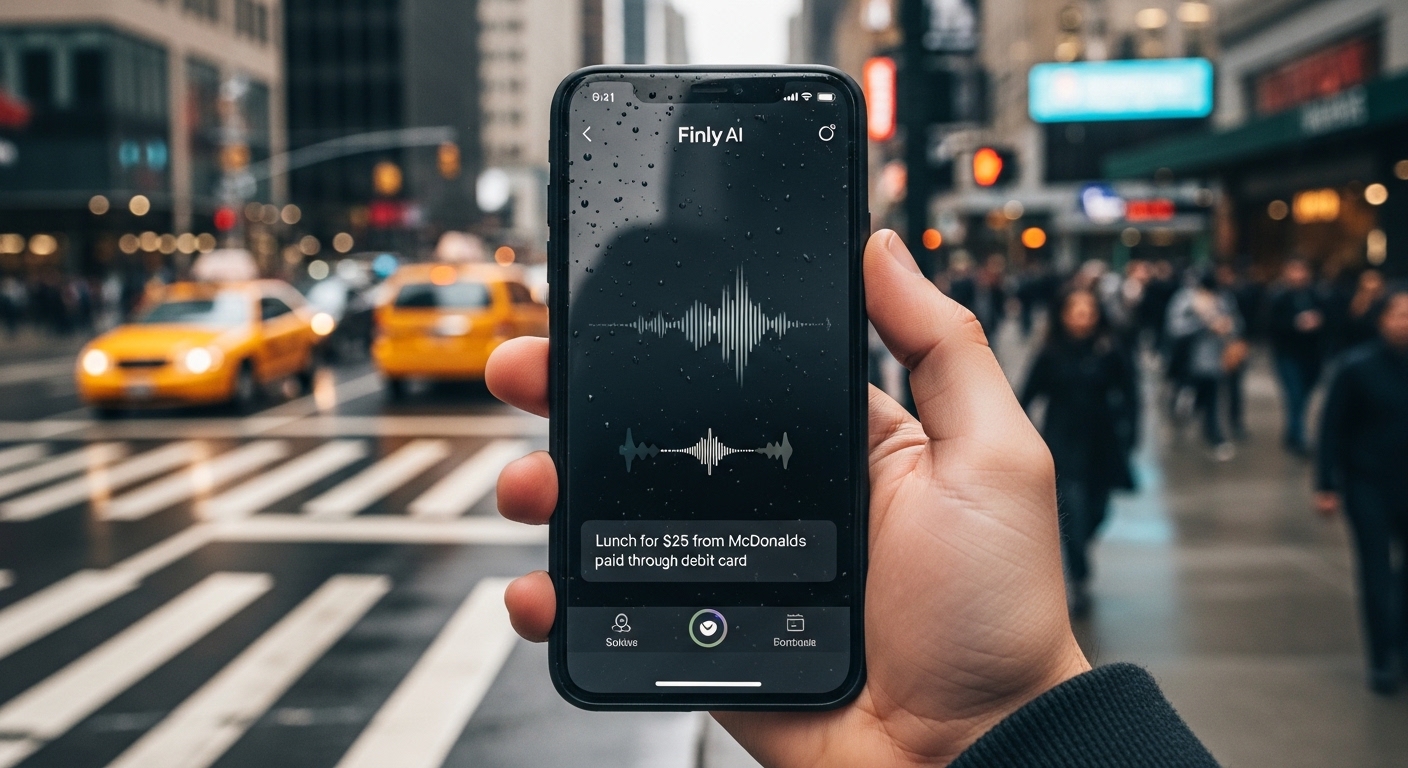
So I integrated a 3-stage AI pipeline. It's not just "dictation." It's an intelligent parser. Now, the workflow looks like this:
- I buy a sandwich.
- I tap one button and say: "Spent 15 bucks on lunch at Joe's using my Amex."
- Finly extracts: Amount ($15), Category (Food), Merchant (Joe's), and Account (Amex Gold).
- It timestamps it and closes.
Total time: 2.4 seconds.
The best part? It uses Natural Language Processing (NLP) to detect context. If you say "Transfer 500 to Savings," it knows it's a transfer, not an expense. If you say "Paid rent," it knows it's a bill.
And if you're in a crowded bar? You can just type it. "Beer $12 cash." Done. It gives you the speed of automation with the privacy of a local database.
The Tech Stack (For the nerds)
I built Finly using React Native because I wanted a truly native feel on both iOS and Android without maintaining two codebases. The backend serves one main purpose: syncing your data between your devices.
We use standard, industry-grade encryption for data in transit and at rest. But the real security isn't just the code; it's the lack of incentive. Since we don't sell ads or leads, we have zero reason to mine your transaction history. That's not just good security; it's good business alignment.
This Is Just Day 1
Finly is young. We're a small team (literally just me and some AI helpers). We don't have VC money. We don't have a massive marketing budget. We aren't trying to "growth hack" our way to an IPO.
But we have something better: Alignment.
When you use Finly, you aren't a data point. You're a customer. You pay a fair price for a tool, and the tool works for you. That's the old-school way of doing business, and I think it's due for a comeback.
In a world of surveillance capitalism, privacy is the ultimate luxury product. But I believe it should be a standard feature.
Welcome to the privacy revolution.